Candidate-Job Match Scoring: Why the Explanation Matters More Than the Score
Sarwar Hossain · Tue Sep 15 2026
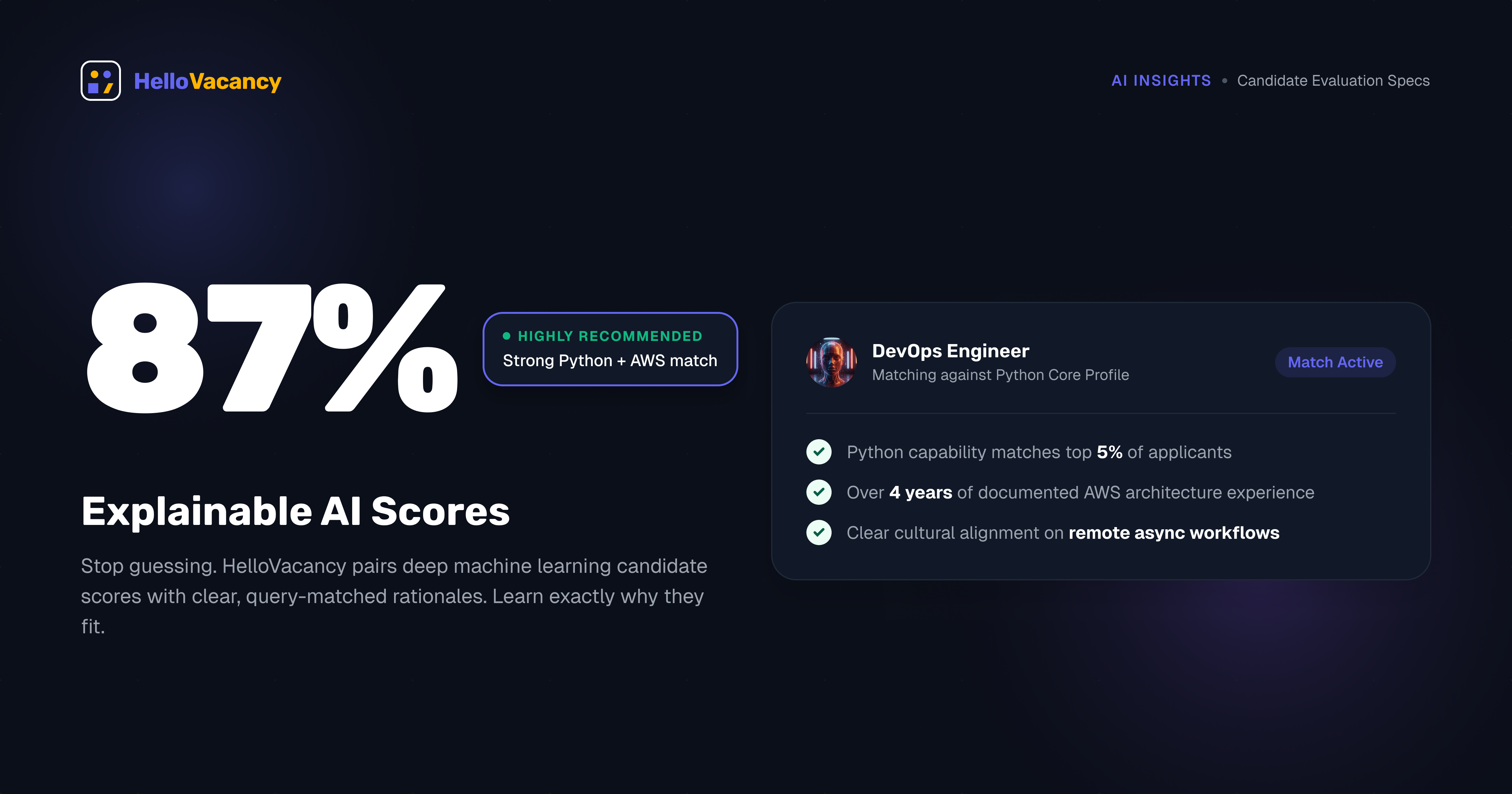
Most "AI matching" features in hiring tools are marketing dressed up as intelligence numbers with no reasoning behind them, presented as if they're self-evidently trustworthy. We think that's the wrong way to ship this feature, and we built ours the opposite way on purpose.
What We Actually Built
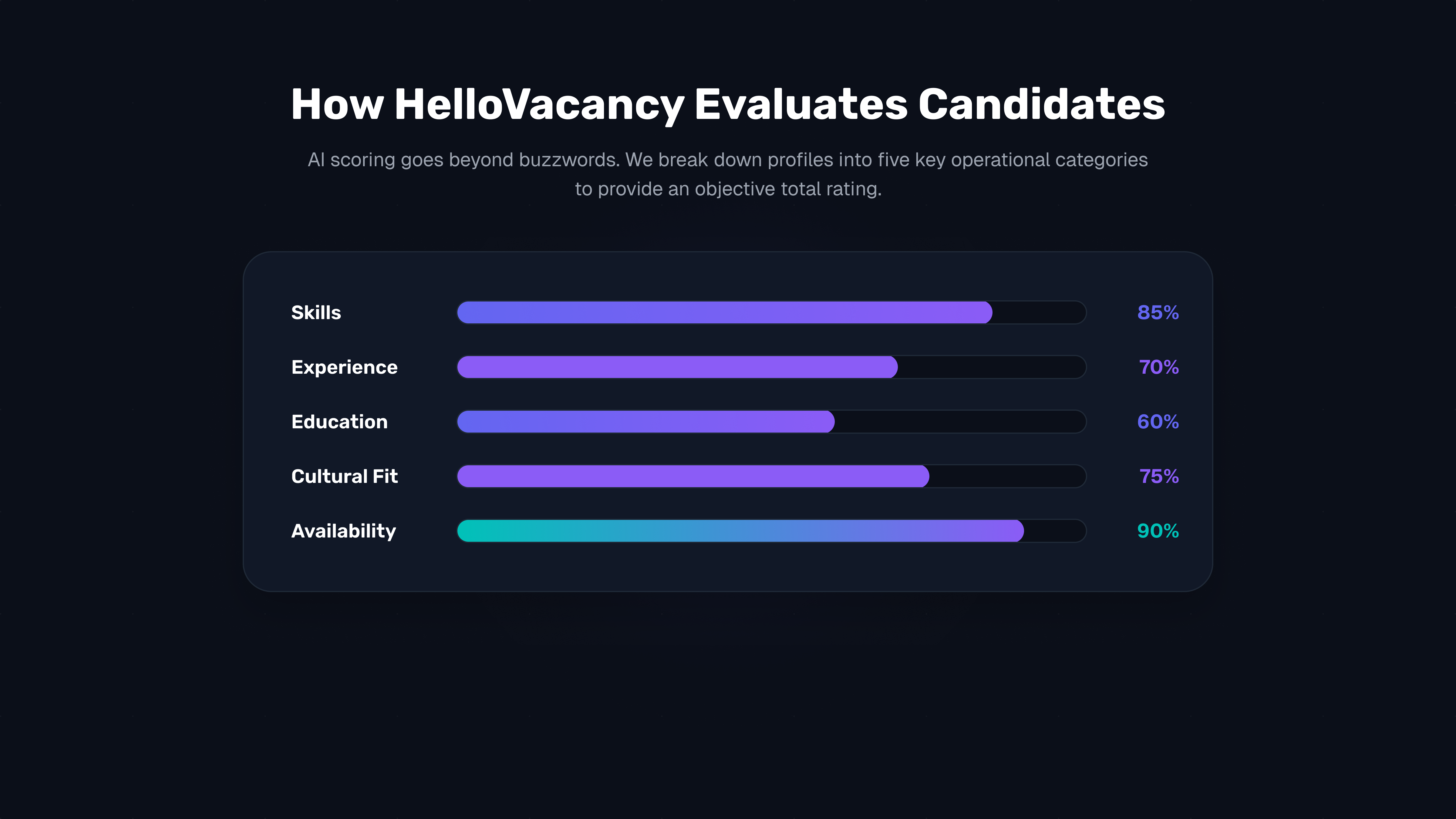
Match scoring compares a candidate's parsed CV, application answers, and cover letter (if provided) against the job's stated requirements. It doesn't stop at a single number. It breaks the comparison down by category skills match, experience match, education match, cultural fit, availability before landing on an overall score and a plain-language recommendation: Strong Fit, Good Fit, Moderate Fit, or Weak Fit.
Here's the part that actually matters: every score ships with a strengths list, a gaps list, and a one-sentence summary of why. Not "this candidate scored 74." Instead: "this candidate scored 74 because their technical skills are strong, but they're missing the specific tool experience you asked for, and their stated availability doesn't match your start date."
One of those you can act on. The other you just have to believe.
How It Actually Works, Technically
The scoring doesn't run keyword matching against a resume that approach misses candidates who describe the same skill differently than the job post does. It works from the structured data already extracted during CV parsing skills, years of experience, seniority level, education, work history cross-referenced against the requirements you set on the position, weighted by category. If parsed data is incomplete for any reason, the system re-parses before scoring rather than silently scoring against a gap.
This matters because it means the score is only ever as good as its inputs, and those inputs are visible you can see exactly what was extracted from a CV, not just trust that "the AI read it."
Why the Explanation Is the Actual Feature
This isn't a UX nicety. It solves two real problems at once.
For the recruiter, an unexplained score is a black box you either trust blindly or ignore entirely. An explained score is something you can sanity-check if the reasoning looks off (say, it penalized someone for a skill that isn't actually required), you catch that immediately instead of quietly trusting a bad number.
For the candidate, this is arguably more important. Explicit, reviewable criteria are one of the more effective ways to reduce bias in a hiring process you genuinely can't fix what you can't see. A hiring process that can't explain its own decisions isn't more objective than a human one; it's just opaque in a new way.
What We Think Everyone Else Gets Wrong
The industry default is to treat the score as the product and the reasoning as an afterthought, if it exists at all. We built it the other way around: the reasoning is the product, and the score is just a compressed summary of it. If we ever had to choose between a more accurate-sounding number and a fully explainable one, we'd take explainable every time a score nobody can question isn't actually more useful, it's just harder to catch when it's wrong.
Start Free
Every match score on HelloVacancy shows its work, every time. Start free at hellovacancy.com and see the reasoning behind every candidate's score, not just the number.